

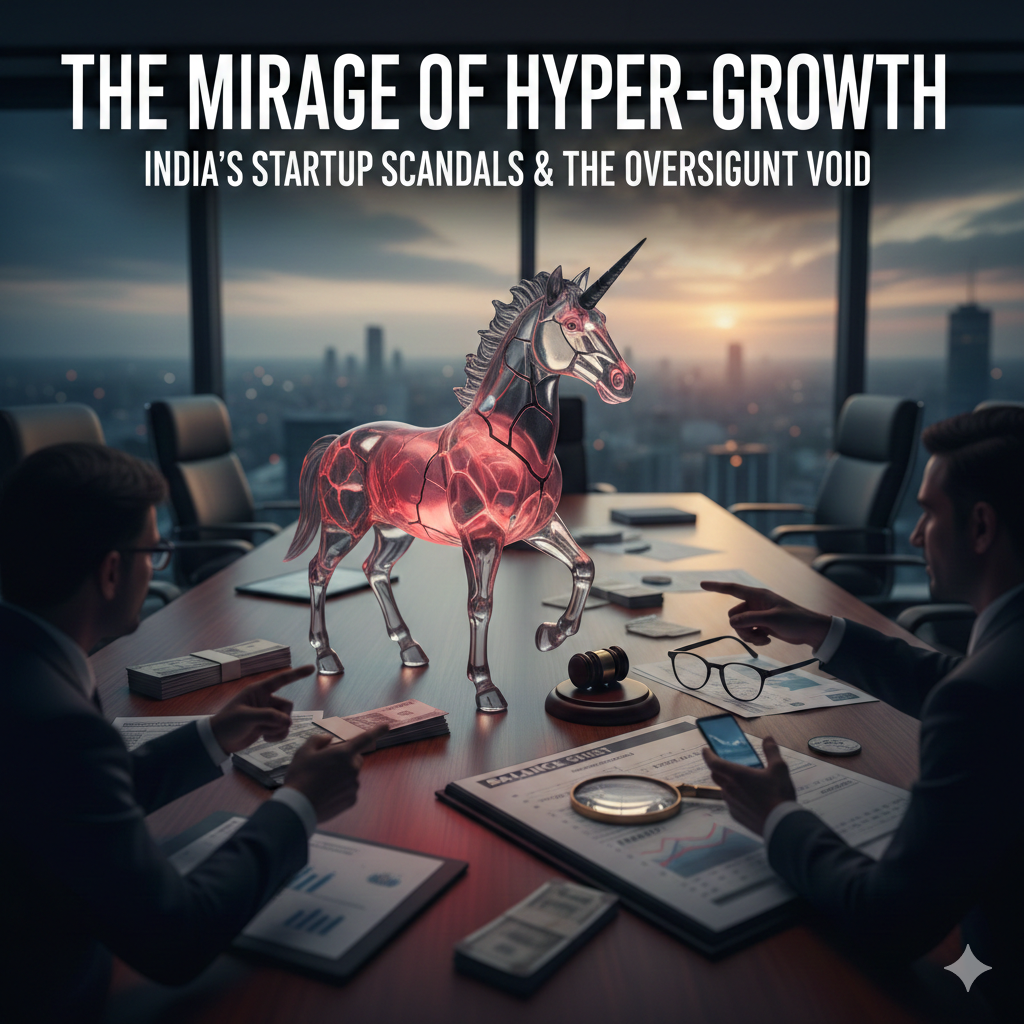
Executive Summary: The Accountability Crisis in Indian Startups
The “Golden Age” of Indian startups is facing a terminal reckoning. Driven by a “growth-at-all-costs” mantra and fueled by foreign capital, several high-profile unicorns—from Byju’s and BharatPe to Lido Learning—have seen their valuations crumble under the weight of governance failures. This article investigates the systemic “oversight void” that allowed founders to treat public and investor money as personal “piggy banks.” With the April 2025 SEBI interim order exposing a ₹262 crore fund diversion at Gensol/BluSmart and the subsequent forensic audit initiated by Grant Thornton Bharat LLP , the narrative has shifted from innovation to integrity. We explore the severe legal consequences under the Companies Act, 2013, and argue that salvaging the “India Brand” requires a radical return to fiscal discipline and empowered independent oversight.
For the better part of a decade, the Indian startup ecosystem has been the crown jewel of emerging markets. Powered by a “digital-first” population and regulatory tailwinds, it promised exponential returns. However, the veneer of innovation has recently begun to crack, revealing a troubling pattern of financial irregularities, nepotism, and systemic oversight failures.
From the outside, these companies appeared to be unicorns in the making; from the inside, they were often houses of cards, built on a foundation of unchecked founder power and a “growth-at-all-costs” mantra that blinded even the most seasoned global venture capitalists.
The hall of Infamy: Case Studies in Governance Failure
The scale of the problem is best understood through the wreckage of once-celebrated brands. As noted in a comprehensive analysis by Taranjeet Singh Slatch in his article, Top 5 Biggest Startup Scams in India, the ecosystem has been rocked by high-profile collapses that were often preventable.
- The BluSmart & Gensol Scandal (2025-26): In one of the most significant recent blowouts, SEBI issued an interim order in April 2025 against the founders of the EV ride-hailing pioneer, BluSmart. The investigation into its affiliate, Gensol Engineering, revealed that approximately ₹262 crore in loan funds intended for electric vehicles was reportedly diverted. Allegations include siphoning money for personal luxury—including a ₹43 crore Gurugram apartment and high-end golf equipment—while employees faced salary disruptions. Both founders have since been barred from the securities market.
- The Byju’s Insolvency (2025-26 Update): Once India’s most valuable startup, Byju’s parent company, Think & Learn, is currently navigating a grueling insolvency process. In late 2025, the Supreme Court of India dismissed a plea by Byju Raveendran to halt these proceedings, reinforcing a critical legal precedent: once a Committee of Creditors (CoC) is formed, private settlements cannot be used to “short-circuit” the statutory insolvency process.
- The BharatPe Resolution (2024-25): The long-running saga involving Ashneer Grover reached a definitive conclusion in late 2024. After years of public spats and allegations of misappropriated funds through fictitious vendors, Grover entered a settlement agreement, officially severing all ties and shareholding in the company. His relative, Deepak Gupta, was arrested in connection to the fraud before being granted bail, marking the end of a era defined by “founder-nepotism.”
- The Expulsion at Zilingo: The e-commerce fashion world was rocked when Singapore-based CEO of Indian origin, Ankiti Bose, was expelled following reports of accounting irregularities. This proved that even startups in regulatory hubs are not immune to “mirage metrics” if board oversight is purely cosmetic.
The EdTech Mirage: Where Numbers Are “Creative Writing”
The EdTech sector became the ground zero for “metric manipulation,” where revenue was often recognized aggressively to mask terminal burn rates.
- WhiteHat Junior: Famous for the fictitious “Wolf Gupta” marketing ploy, the company’s internal governance featured revenue recognition policies that eventually contributed to massive losses for its parent company, proving that marketing hype is no substitute for unit economics.
- Lido Learning: Despite raising over $23 million, Lido was losing nearly $6 for every $1 earned. While founders pushed for international expansion, they were reportedly using new funding to pay off old debts—a classic “robbing Peter to pay Paul” scenario that led to its total collapse.
- TinyOwl: An early warning of the “burn-rate” crisis, where the cost of customer acquisition tripled while service quality plummeted, hidden from the board until the cash—and the trust—ran dry.
Legal Implications Under Indian Corporate Law (2025-26 Update)
The era of the “unvetted unicorn” is meeting the cold reality of the Companies Act, 2013 and the SEBI Act, 1992. Regulators are no longer waiting for a total collapse to intervene; they are now deploying “preventative strikes.”
1. Section 11 & 11B (The “Piggy Bank” Precedent)
In the landmark April 2025 order against the promoters of Gensol Engineering (the vehicle provider for BluSmart), SEBI used its powers to immediately bar founders from the securities market.
- Asset Freezing: SEBI specifically flagged the use of company funds to acquire personal luxury—including a ₹42 crore luxury apartment at DLF Camellias and high-end golf gear—treating it as a violation of PFUTP Regulations (Fraudulent and Unfair Trade Practices).
- The Audit Trigger: The order mandated a full forensic audit, subsequently awarded to Grant Thornton, to trace “layered transactions” involving mothers, wives, and even other startups like Ashneer Grover’s Third Unicorn.
2. Section 447 (Punishment for Fraud)
This remains the most feared provision in Indian law. In 2025, authorities have lowered the threshold for “intent,” meaning that even “gross negligence” by a board can trigger criminal fraud charges.
- Fiduciary Failure: Founders can face up to 10 years of imprisonment for siphoning funds, while Independent Directors who turned a blind eye are now being held personally liable for “unjust enrichment.”
3. Multi-Agency “Waterfall” Investigations
Regulatory coordination has reached a new peak in 2026. A single SEBI order now triggers parallel probes by:
- SFIO (Serious Fraud Investigation Office): Investigating the systemic breakdown of internal controls.
- ICAI (Audit Regulator): As of February 2026, the Financial Reporting Review Board (FRRB) has referred the audit books of Gensol and BluSmart to its disciplinary committee to investigate whether statutory auditors failed to spot forged “No-Default” letters.
4. The Supreme Court & IBC Precedent (2025)
Regarding the Byju’s insolvency, the Supreme Court ruled that once the Insolvency and Bankruptcy Code (IBC) is triggered, founders cannot reclaim control via “backdoor” private settlements. This ensures that creditors and employees take precedence over founder equity.
The Path to Redemption: Salvaging the “India Brand”
To restore faith, the narrative must shift from valuation to value creation. The reputation of Indian startups can only be salvaged through a radical return to corporate hygiene:
- Empowering Independent Directors: Boards must move beyond being “founder support groups.” They must have the mandate to veto related-party transactions and enforce fiscal discipline.
- Mandatory Forensic Audits: For startups reaching a certain valuation threshold, annual forensic audits by third-party firms should be mandatory to ensure reported metrics match bank statements.
- Investor Accountability: Foreign investors must move away from “observer” roles and appoint experienced CFOs who report directly to the board, not the CEO.
The Indian startup story is far from over, but the era of the “unvetted unicorn” must end. If we do not act now to instill a culture of accountability, the next wave of capital may decide that the Indian dream is simply too risky to finance.