

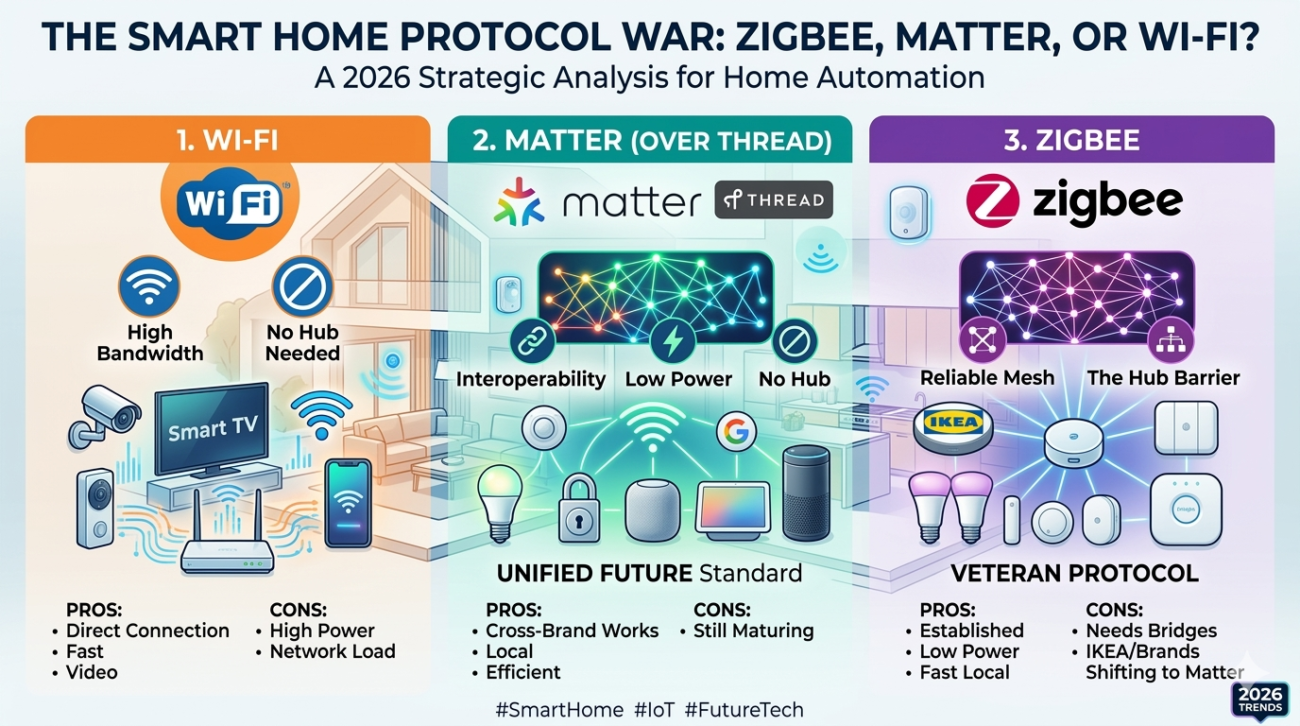
The “language” of our homes is changing. For over a decade, Zigbee was the undisputed king of local, mesh-based smart home networking. But as we move deeper into 2026, the landscape has fundamentally shifted. Major players are moving away from proprietary bridges, and a new unified standard is finally delivering on the promise of a “frictionless” smart home.
If you are planning a smart home strategy today—whether as a consumer or a developer—choosing between Zigbee, Matter, and Wi-Fi is the most critical decision you’ll make.
1. Wi-Fi: The Universal Entry Point
Wi-Fi is the most common protocol because it requires no extra hardware. Every smartphone and router already speaks it.
- Pros: High bandwidth (perfect for cameras and video doorbells), no hub required, and ubiquitous availability.
- Cons: Battery killer. Wi-Fi is power-hungry; you won’t find a Wi-Fi motion sensor that lasts two years on a coin battery. It also risks “network congestion”—if you have 50+ smart bulbs on a standard router, your Netflix stream might start to lag.
- Best For: Security cameras, smart TVs, and heavy appliances.
2. Zigbee: The Aging Gold Standard
Zigbee built the modern smart home. It uses a “mesh” network where every plugged-in device acts as a repeater, extending the range throughout your house.
- Pros: Extremely low power consumption and battle-tested reliability. It operates locally, meaning your lights still work even if your internet goes down.
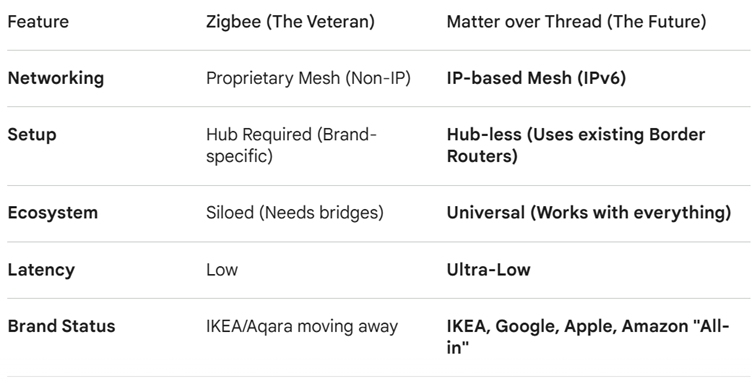
- Cons: The “Hub Problem.” Zigbee doesn’t speak the same language as your phone (IP-based). You need a translator (a Bridge/Hub) for every brand—one for Philips Hue, one for Ikea, one for Aqara.
- The Trend: While Zigbee 3.0 improved things, the industry is moving toward IP-based solutions that don’t require these proprietary “middleman” boxes.
3. Matter: The New Unified Language
Matter isn’t just another protocol; it’s an industry-wide “seal of approval” that runs over Wi-Fi and Thread (a newer, better version of Zigbee’s mesh technology).
- Pros: Universal Interoperability. A Matter-certified device works with Apple Home, Amazon Alexa, and Google Home simultaneously. It offers the low power of Zigbee with the “no-hub-needed” direct connection of Wi-Fi.
- Cons: Still maturing. While the foundation is solid, some advanced features (like specific light scenes) can still be brand-limited.
- Best For: Future-proofing. If you’re buying a new device today, look for the Matter logo.
Technical Trends: The 2026 Inflection Point
The smart home industry is currently undergoing its most significant infrastructure overhaul since the introduction of Wi-Fi. Here are the three technical shifts driving the transition:
1. The IKEA “Matter-over-Thread” Offensive
In a move that has sent ripples through the industry, IKEA officially discontinued its legacy TRÅDFRI Zigbee line in early 2026. Replacing it is the new Kajplats range—a collection of over 20 lighting and sensor products that run exclusively on Matter-over-Thread.
- The Research Result: IKEA’s internal testing found that moving to an IP-based standard (Thread) reduced “hub fatigue” for consumers by 40%. By adopting Matter, IKEA eliminated the need for their proprietary DIRIGERA bridge for users who already own a compatible device from Apple or Google.
- The Industry Signal: When the world’s largest furniture retailer pivots, the supply chain follows. Silicon vendors are now prioritizing “multi-protocol” chips (supporting both Zigbee and Thread) to help other brands manage this multi-year transition.
2. The Rise of “Invisible” Thread Border Routers
The “Hub” is dying, but the “Border Router” is taking its place—and you probably already own one. A Thread Border Router is the bridge that connects your low-power mesh devices to your home Wi-Fi/Ethernet.
- Ubiquity as a Trend: In 2026, Thread Border Routers are no longer separate plastic boxes. They are now natively built into:
- Smart TVs (Samsung and LG’s 2025/26 lineups)
- Wi-Fi Routers (Nest Wifi Pro and Eero 6/7)
- Smart Speakers (HomePod Mini, Echo Dot 5th Gen)
- The Technical Edge: Unlike Zigbee hubs, which are brand-locked, any Thread Border Router can support any Matter-over-Thread device, regardless of the manufacturer.
3. Local Control vs. Cloud Dependency
A major trend in 2026 research is the “Local-First” movement.
- Zigbee’s Legacy: Zigbee was always local, but its lack of native IP support meant it often required cloud-based bridges to talk to your phone.
- Matter’s Advantage: Matter allows your phone to talk directly to your lightbulb over your local network using IPv6. This means even if your ISP has an outage, your complex automations—like your “Goodnight” routine—will execute with zero latency.
Expert Insight: ABI Research (2026) suggests that while Zigbee will remain a “dominant legacy solution” for the next decade, its market share for new device shipments has officially been overtaken by Matter-compatible protocols.
While legacy Zigbee devices will be “bridged” into these systems for a few more years, the research is clear: new hardware development is almost exclusively shifting toward Matter-over-Thread.
The 2026 Smart Home Buyer’s Checklist
The market is in a “transition year.” To avoid buying hardware that will be obsolete by 2028, follow this simple framework for your next purchase:
✅ Prioritize Matter-over-Thread for “Small” Devices
For sensors, light bulbs, and remotes, Thread is now the gold standard.
- Check the box: Look for the Matter logo and the word Thread.
- Why? It ensures your devices talk to each other locally without needing a brand-specific hub (like the old IKEA or Hue bridges).
✅ Stick to Wi-Fi for “Heavy” Data
Don’t try to find a Thread-based security camera or smart TV yet.
- Check the box: Ensure your Wi-Fi devices are Matter-certified (specifically Matter 1.5, which recently added advanced support for cameras and high-bandwidth data).
- Why? Wi-Fi has the “bandwidth” for video and audio that low-power mesh networks simply can’t handle.
✅ Audit Your “Border Routers”
Before buying more hubs, see what you already own. In 2026, many devices act as “Thread Border Routers” (the bridge between your smart devices and your Wi-Fi).
- Check if you own: * Apple HomePod (2nd Gen) or Apple TV 4K.
- Google Nest Hub Max or Nest Wifi Pro.
- Amazon Echo (4th Gen or newer).
- Any 2025/2026 model Samsung or LG Smart TV.
- Pro Tip: If you own one of these, you likely do not need to buy a separate hub for new Matter-over-Thread devices.
✅ The “Legacy” Rule for Zigbee
Should you buy Zigbee today?
- Yes, IF: You are an enthusiast using Home Assistant or you are expanding an existing, stable system like Philips Hue. Zigbee is still incredibly reliable and often cheaper.
- No, IF: You are just starting your smart home journey. Avoid the “Hub Trap” and go straight to Matter.
Final Thoughts: The End of the “Walled Garden”
The shift we’re seeing with IKEA and other giants moving toward Matter isn’t just a technical upgrade—it’s a win for the consumer. We are finally moving away from “Is this compatible with my phone?” to “Does this work in my home?”
The infrastructure is ready. Now, it’s just a matter of choosing the right devices.
What protocol are you betting on for your home or office? Drop a comment below—I’d love to hear your experiences with Matter so far!