

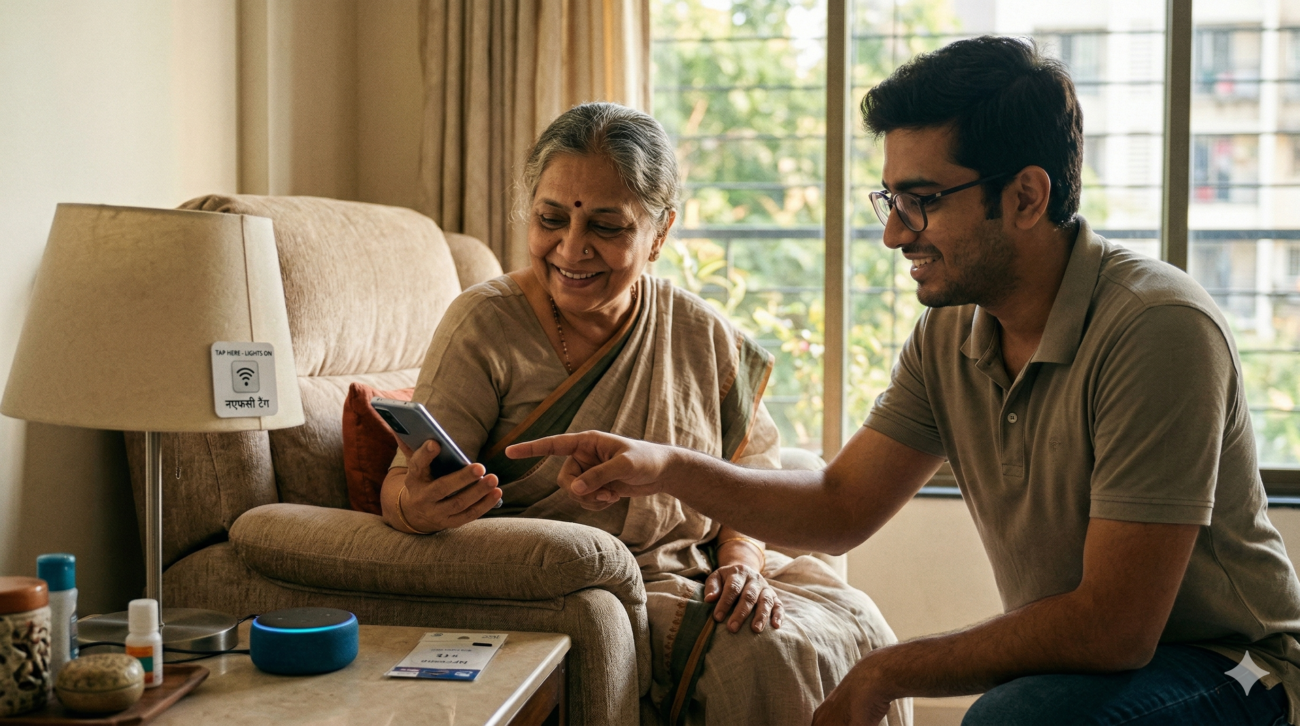
We often talk about the “Smart Home” as a playground for the tech-savvy. We imagine voice-controlled hubs, complex apps, and expensive installations. But for a 70-year-old with a slight tremor, or someone living with a cognitive or physical disability, a “smart” home can feel incredibly alienating.
Complexity is the enemy of accessibility. When an interface is invisible (like voice) or layered (like a smartphone app), it creates a cognitive load that often leads to one result: the user gives up.
But there is a low-cost, zero-learning-curve solution hiding in plain sight: The NFC Tag.
The Power of the Physical “Tap”
NFC (Near Field Communication) tags are small, passive adhesive stickers. In India, they are remarkably affordable, typically costing between ₹15 and ₹20 each. They require no batteries and can be stuck anywhere—on a bedside table, a pill bottle, or even a walker.
The beauty of NFC is its tactile simplicity. Instead of navigating a phone menu, a user simply “taps” their phone against a physical sticker to trigger a complex action. Experts agree that this physical-to-digital link is a game-changer.
“The simplicity of the physical ‘tap’ interaction is crucial. For someone with fine motor skill challenges or cognitive impairments, this is infinitely easier than navigating menus. It empowers them to control their environment directly.” — Assistive Technology Specialist
Real-Life Case Studies: Small Tags, Big Impact
The feasibility of this “low-tech” automation is already being proven worldwide:
- Dementia Safeguarding (UK): The Avon and Somerset Police launched a scheme using NFC-enabled wristbands. It resulted in a 66% reduction in repeat missing person incidents, as passersby could tap the band to instantly get emergency contact info.
- The “Speaking” Pharmacy: Research by the IEEE Computer Society showcased the PharmaFabula project. By placing NFC stickers on medication, visually impaired users tap their phone to hear dosage instructions and expiry dates read aloud—removing the risk of medication errors.
- Autonomy in ASD: Studies with adolescents on the Autism spectrum found that NFC “Visual Schedules” (tapping a desk to open a video tutorial for a chore) significantly reduced anxiety and increased confidence by providing instant, predictable guidance.
Bridging the Gap: The Alexa Connection
While a tag can do simple things natively (like calling a son or daughter), its true power is unlocked when linked to smart ecosystems.
For complex tasks—like locking the front door, turning off the geyser, and dimming the lights simultaneously—NFC tags can interface with Amazon Alexa.
- The Setup: This requires a one-time, free setup using intermediary tools like MacroDroid or IFTTT to create a “Virtual Trigger.”
- The Result: Once configured by a caregiver, the elder never has to touch the Alexa app again. They simply tap the sticker on their nightstand, and the house follows suit.
DIY Quality-of-Life Hacks
Here is how you can implement this today for less than the price of a cup of coffee:
- The “I’m Home” Door Tag: Tap the doorframe upon entering to auto-send a WhatsApp: “I’ve reached home safely.”
- The Audio Manual: Stick a tag on the microwave; a tap opens a YouTube video explaining how to use it.
- The Emergency Beacon: A tag on a walker or wheelchair that, when tapped, dials emergency services and shares the user’s GPS location.
How to Get Started
- Procure: Buy a pack of NTAG213 or NTAG215 stickers from any major Indian e-tailer.
- Program: Use the free NFC Tools app (Android/iOS) to write your command.
- Stick & Simplify: Place them where they are needed most.
By returning to a tactile, physical interaction, we can make technology disappear into the background. It turns out the most sophisticated way to improve quality of life isn’t a new gadget—it’s a ₹15 sticker that makes the gadgets we already have actually work for everyone.
Comment below to get a free, step-by-step DIY guide on setting up NFC system, along with 3 automation routines and a BONUS Pro tip.