

The Ministry of Electronics and Information Technology (MeitY) recently paused Meta’s anticipated rollout of the WhatsApp username feature in India. On one hand, replacing visible phone numbers with alphanumeric handles is a major milestone for user privacy. On the other hand, the government’s sudden pause highlights an increasingly urgent reality: the weaponization of digital identity.
While this progressive feature offers massive privacy benefits, it also demands rigorous digital guardrails to ensure user protection.
The Core Dilemma: Balancing Privacy and Fraud Risk
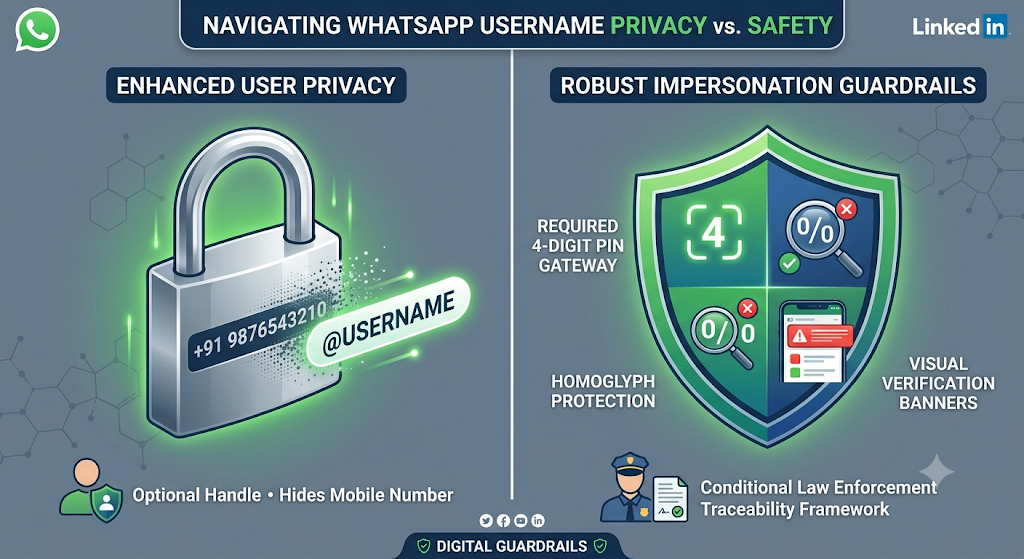
Currently, joining a residential society group, a casual hobby circle, or a professional networking forum means exposing your personal phone number to hundreds of strangers. The username feature elegantly solves this by allowing users to connect via an optional handle (e.g., @JohnDoe_99), keeping their core identity anchor—the mobile number—hidden.
However, regulatory concern is entirely justified. In an era rampant with “digital arrest” scams, phishing, and executive spoofing, removing visible phone numbers strips away a basic verification tool. If lookalike usernames like @BiipinPreet_Singh or @G0vt_Verify slip through, the friction for bad actors drops significantly, raising the potential for sophisticated social engineering.
4 Crucial Guardrails for a Secure Rollout
To maximize privacy without compromising digital safety, structural protections must be integrated directly into the ecosystem:
1. Mandating the “Username PIN” by Default
Meta has introduced a 4-digit username key or PIN, which acts as a gateway before a stranger can initiate a chat. To make this effective, it should be enabled by default for all new accounts. Knowing a username shouldn’t be enough to drop a message; the user must actively share their PIN code to open the door.
2. Proactive Homoglyph & Lookalike Blocking
We need an algorithmic safety net that blocks character substitutions, often called homoglyph attacks—such as using a zero 0 for an O, or a lowercase l for an uppercase I. Advanced detection systems must dynamically flag and freeze registrations that closely mirror existing public figures, enterprise brands, or government institutions.
3. Clear Visual Differentiation in Chat UI
The interface must distinctly separate human verified profiles from standard users. If a user claims to be a brand or public figure, the platform should employ mandatory color-coded badges (e.g., green for verified businesses, blue for public individuals) within the chat thread itself. If a non-contacts handle initiates a chat, a highly visible banner should state: “This user is not in your contacts and is masking their phone number.”
4. A Conditional Traceability Framework
To appease law enforcement without dismantling end-to-end encryption, a strict legal protocol must exist. While ordinary citizens enjoy hidden numbers, WhatsApp must establish an accelerated mechanism to securely furnish the registered mobile number associated with a specific username when served with valid, legally sanctioned judicial warrants.
Moving Forward Responsibly
Privacy and public safety do not have to be a zero-sum game. By implementing these proactive safeguards, we can enjoy a safer digital ecosystem that protects individual anonymity from the crowd while keeping the platform hostile to bad actors.
What are your thoughts on this? Will you switch to a username immediately, or stick to phone numbers for accountability? Let’s discuss in the comments.